What Is a Postal Code? Meaning, Examples, How to Find Yours
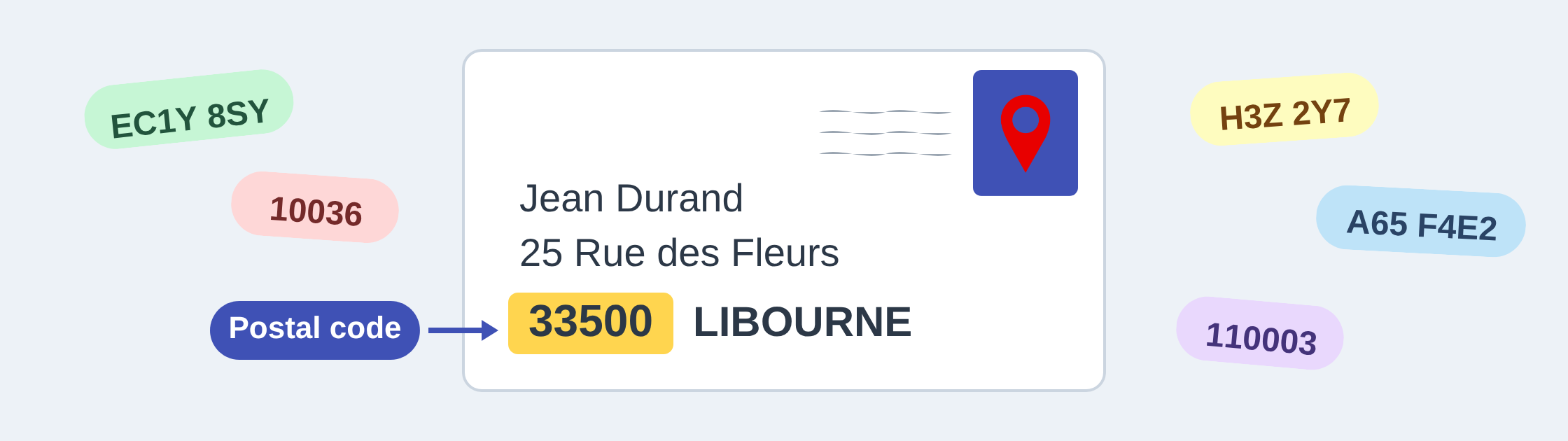
A postal code is a short group of numbers, or letters and numbers, that stands for one area. The post office uses it to sort mail quickly. Most forms and online shops ask for it together with your address.
75007.Table of contents
- Why Do We Need Postal Codes?
- What Does a Postal Code Mean?
- Postal Code Examples From 6 Countries
- ZIP Code, Postcode, PIN: Are They the Same?
- How to Find Your Postal Code
- Common Mistakes With Postal Codes
- Frequently Asked Questions
Why Do We Need Postal Codes?
Every day, post offices move huge numbers of letters and parcels. Each one has to go from the sender to the right street, often through several sorting centres on the way. Reading every town and street name by hand would be slow.
A postal code makes this faster. It is short, it follows a fixed pattern, and a sorting machine can read it. The machine looks at the code and sends the letter to the right place, one step at a time. The US Postal Service, for example, started ZIP codes in 1963 because the amount of mail kept growing.
Postal codes also solve a simple problem: many towns and streets share the same name. There is a Springfield in many US states and a Main Street in almost every town. The postal code tells them apart.
Today, postal codes are used outside the post too. Online shops use them to work out delivery times and costs. Websites use them to show the nearest shop or service. That is why so many forms ask for one.
What Does a Postal Code Mean?
A postal code is not a random number. Each part of it makes the area smaller: first a big region, then a town or district, then a few streets.
You can think of it like boxes inside boxes. The first part of the code picks a big box, such as a region or a large city. The next part picks a smaller box inside it. The last part picks the smallest box, the place where the postman finally delivers.
Here is a UK postcode, taken apart the way the Universal Postal Union shows it. The Universal Postal Union is the UN agency for post.
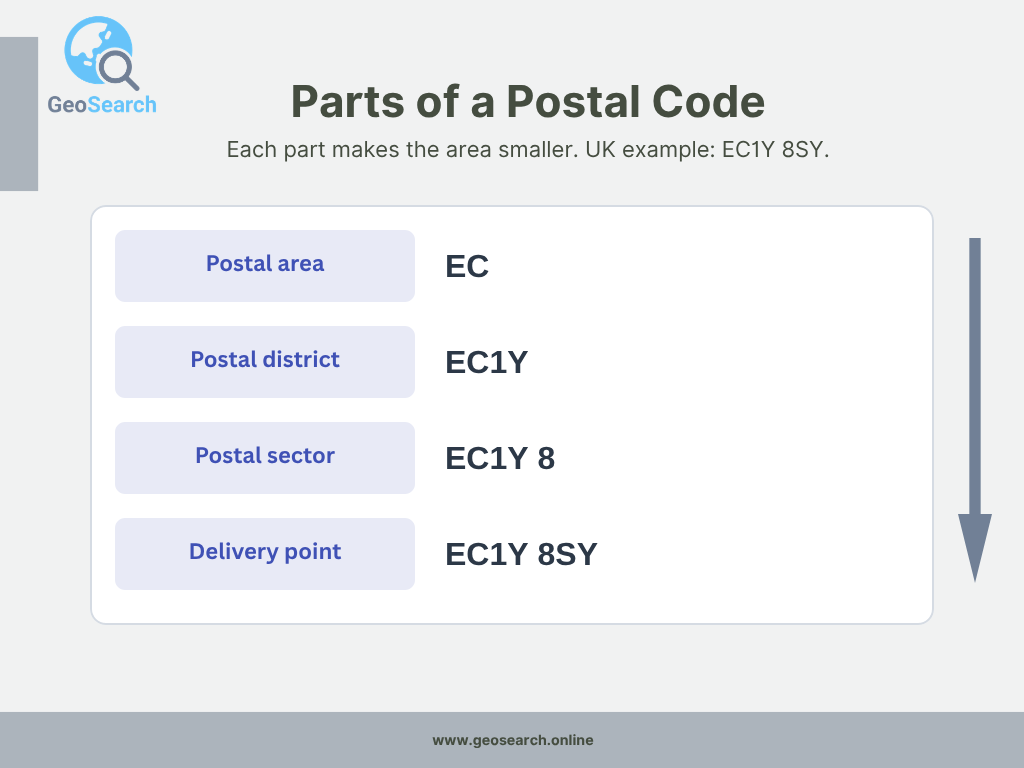
Each part of the postcode makes the area smaller.
| Part | What it means |
|---|---|
EC | The postal area: London EC, in central London. |
EC1Y | The postal district inside that area. |
EC1Y 8 | The postal sector, a smaller part of the district. |
SY | The delivery point, the last step to the address. |
Read it from left to right. EC tells the post that the letter goes to central London. EC1Y narrows it down to one district there. 8 picks a smaller part of that district. SY is the last step: the delivery point.
This is also why your neighbours usually have the same postal code as you, while a big city has many different codes. Paris, for example, uses different codes for its districts, such as 75001, 75007 and 75020.
US ZIP codes work the same way. The first digit is a big part of the country, from 0 in the east to 9 in the west. The next two digits are a region. The last two digits are the local post office.
Sources: the UPU guide for the United Kingdom and USPS: Decoding the ZIP Code.
Postal Code Examples From 6 Countries
Every country makes its own postal codes. Some use only numbers. Others mix letters and numbers. Where the code goes in the address is different too.
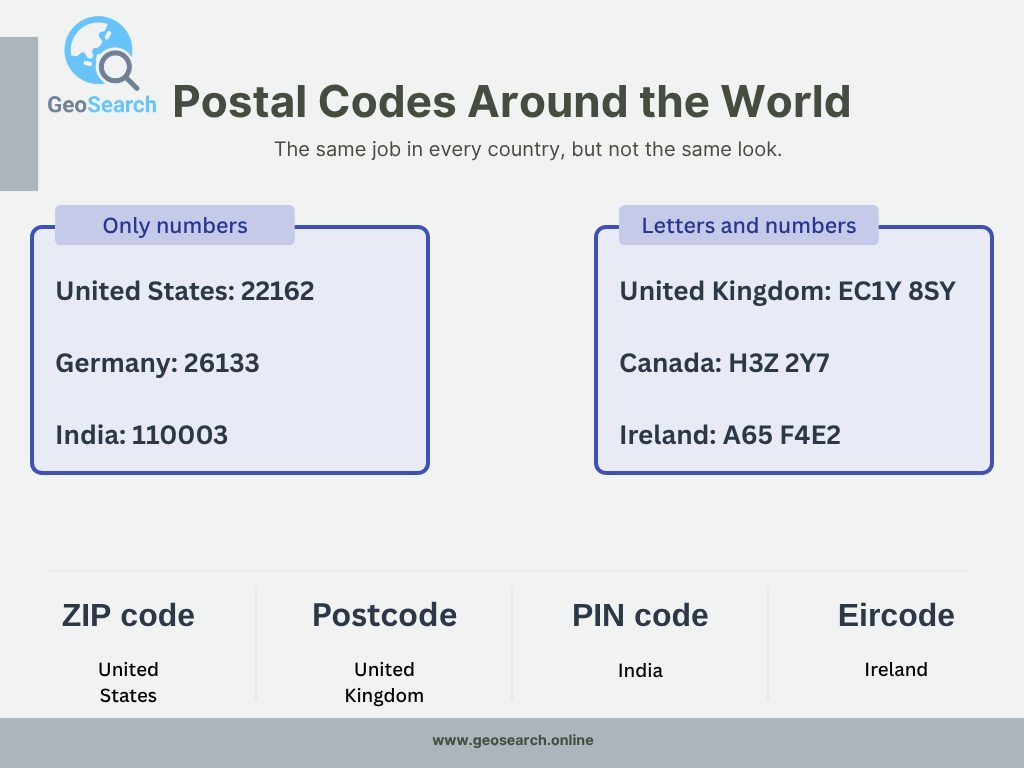
Some countries use only numbers, others mix letters and numbers.
Each country's post service designed its own system, so the codes look different. Numbers only are easy to read and type. Letters and numbers together allow many more different codes in a short space, so the code can point to a smaller area.
The table shows how the code looks in six countries and where it goes in a real address. The examples come from the official address guides.
| Country | Name | What it looks like | Example in an address |
|---|---|---|---|
| United States | ZIP code | 5 digits. ZIP+4 adds 4 more digits after a hyphen. | SPRINGFIELD VA 22162-1010 |
| United Kingdom | Postcode | 5 to 7 letters and numbers, with a space before the last 3. | LONDONEC1Y 8SY |
| Canada | Postal code | Letter, number, letter, space, number, letter, number. | MONTREAL QC H3Z 2Y7 |
| Germany | Postleitzahl (PLZ) | 5 digits, before the town. | 26133 OLDENBURG |
| India | PIN code | 6 digits, after or under the town. | New Delhi110003 |
| Ireland | Eircode | 7 characters: 3 for the area, 4 for the exact address. | A65 F4E2 |
Sources: USPS, the UPU guides for the United States, United Kingdom, Canada, Germany and India, and Eircode.
The parts of the code mean different things in each country, but the idea is always the same: from a big area to a small one.
- Canada: the first three characters, like
H3Z, are the sorting area. The last three, like2Y7, are the local delivery area. - Germany: in
26133, the first digit is a large area, the second is a region, and the last three point to the town or a group of delivery districts. - India: in a PIN code, the first digit is the state or region. The digits after it narrow it down to a sorting centre and finally to the delivery post office.
- Ireland: an Eircode like
A65 F4E2has two parts.A65is the area, shared by many addresses.F4E2is unique to one home or business.
A few rules are easy to get wrong:
- UK and Canada: write the code in capital letters, with one space in the middle.
- Germany: do not write
D-before the postal code. It can slow down sorting. - Ireland: every home and business has its own Eircode, so the full code points to one address, not just an area. Eircodes started in July 2015.
- United States: the 5-digit ZIP code is enough for most forms. The 4 extra digits of ZIP+4, added in 1983, help sort mail down to a street.
Where the postal code goes in the address is part of the country's address format. Our guide to address formatting shows full examples.
ZIP Code, Postcode, PIN: Are They the Same?
Yes. They are different names for the same idea: a short code that helps the post find an address. Each country's post service gave its system its own name, so you will see many names on forms and websites.
| Name | Where it is used |
|---|---|
| ZIP code | United States |
| Postcode | United Kingdom |
| Postal code | Canada, and a common general name |
| PLZ (Postleitzahl) | Germany |
| PIN code | India |
| Eircode | Ireland |
ZIP stands for "Zoning Improvement Plan". The US Postal Service started ZIP codes in 1963 to handle more and more mail.
On a form that says "ZIP or postal code", type the code that belongs to the address you are entering. For an address in Canada, that is the Canadian postal code, even if the website is American.
So when you see "ZIP code" on an American website and you live in the UK, it simply means your postcode. When you see "PIN code" on an Indian form, it means the 6-digit postal code, not a password.
How to Find Your Postal Code
There are three easy ways.
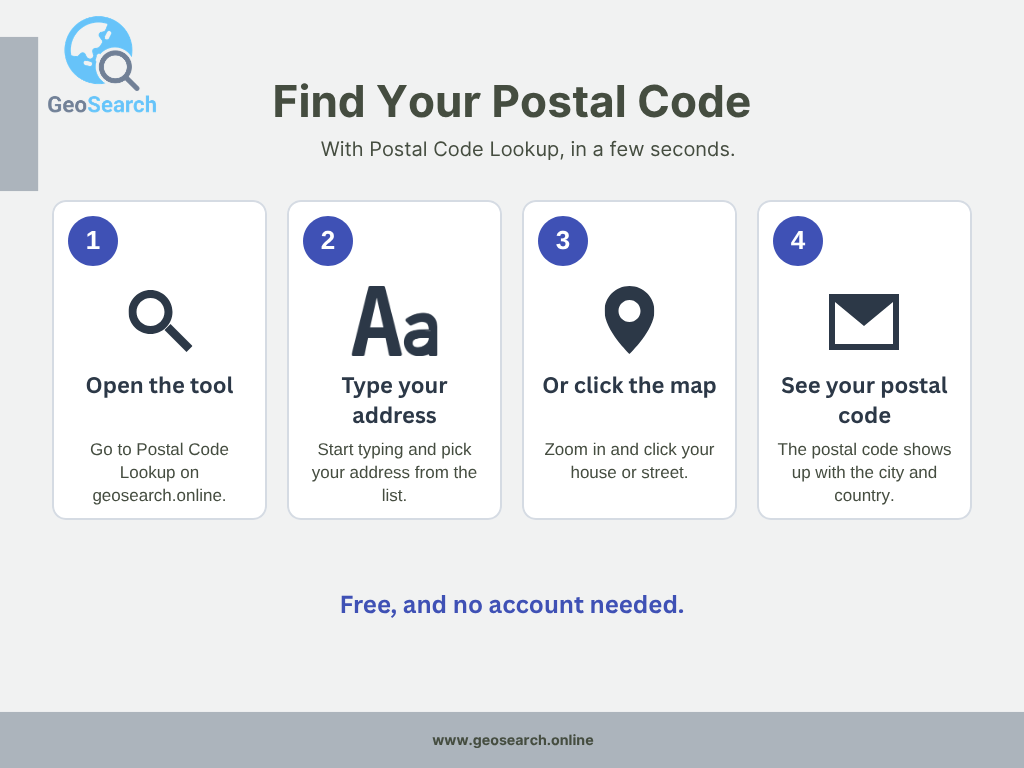
Type your address or click the map, and the tool shows your postal code.
- Look at your mail. A letter or parcel sent to your home has the postal code in the address.
- Use Postal Code Lookup. Type your home address and pick it from the list. Or zoom in on the map and click your house or street. The tool shows the postal code for that place. It works for addresses around the world, it is free, and you do not need an account.
- Ask your post service. Many post services have an official finder, for example the USPS ZIP Code Lookup, the Royal Mail Postcode Finder, Canada Post Find a Postal Code and the Eircode Finder.
What do you get in Postal Code Lookup? Besides the postal code itself, the result shows the city, region and country, and the place on a map. For some postal codes, the map shows the whole area the code covers. For others, it shows one point, because open data does not have the full area for every country.
Postal Code Lookup uses open map and postal data, not official post office records. That is fine for everyday use, like a form or an online order. For official mail, such as bulk mail for a business, check the code with your post service.
Do you live in the US? Find ZIP Code is made for US ZIP codes. Do you have a long list of postal codes or coordinates? Bulk Postal Code Lookup checks the whole file at once.
Common Mistakes With Postal Codes
Most problems with postal codes are small typing mistakes. A form rejects the code, or a parcel takes longer than it should. Here is what to check.
- A missing or extra space. UK, Canadian and Irish codes have one space in the middle:
EC1Y 8SY, notEC1Y8SYorEC1 Y8SY. US ZIP codes, German and Indian codes have no space. - Small letters. Write letters in capitals:
H3Z 2Y7, noth3z 2y7. - A lost zero at the start. Some codes start with
0, like00184in Rome or many US ZIP codes in the east. Spreadsheet programs often treat them as numbers and drop the zeros, so00184becomes184. Format the column as text before you type or paste the codes. - A country letter in front. For Germany, do not write
D-orDE-before the postal code. When you send mail abroad, write the country name on the last line instead. - The wrong country's code. The code must belong to the address on the letter, not to where you are when you fill in the form.
Frequently Asked Questions
What is a postal code in simple words?
Is a ZIP code the same as a postal code?
How many digits is a postal code?
EC1Y 8SY, H3Z 2Y7 or A65 F4E2.