Address Validation Service: What It Checks, How to Choose
Published
You have a list of addresses: customers, club members, wedding guests. Before you send anything, you want to know which addresses have a mistake. An address validation service checks every address for you. Services come in three kinds, and they do not all check the same things.
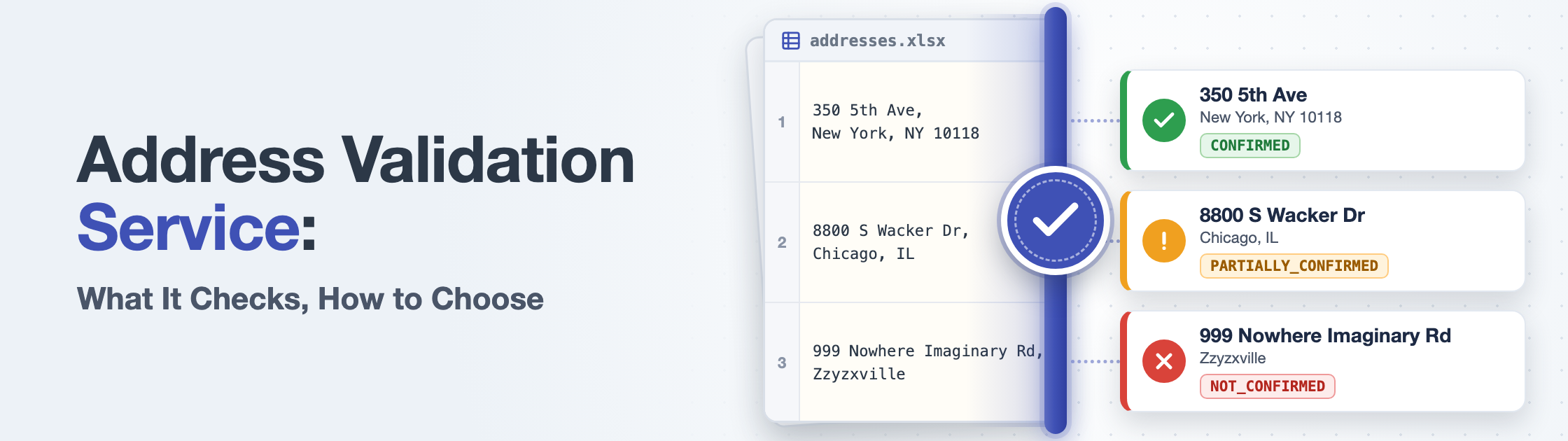
350 5th Ave, New York, NY 10118 comes back as CONFIRMED.Table of contents
- What Does an Address Validation Service Check?
- What a Service Cannot Tell You
- Three Kinds of Address Validation Service
- Which One Do You Need?
- What to Compare Before You Choose
- How to Check a List with GeoSearch.online
- Frequently Asked Questions
What Does an Address Validation Service Check?
A service reads each address and compares it with its address data. Address data is a big collection of known streets, house numbers, cities and postal codes. The service asks four questions about every address.
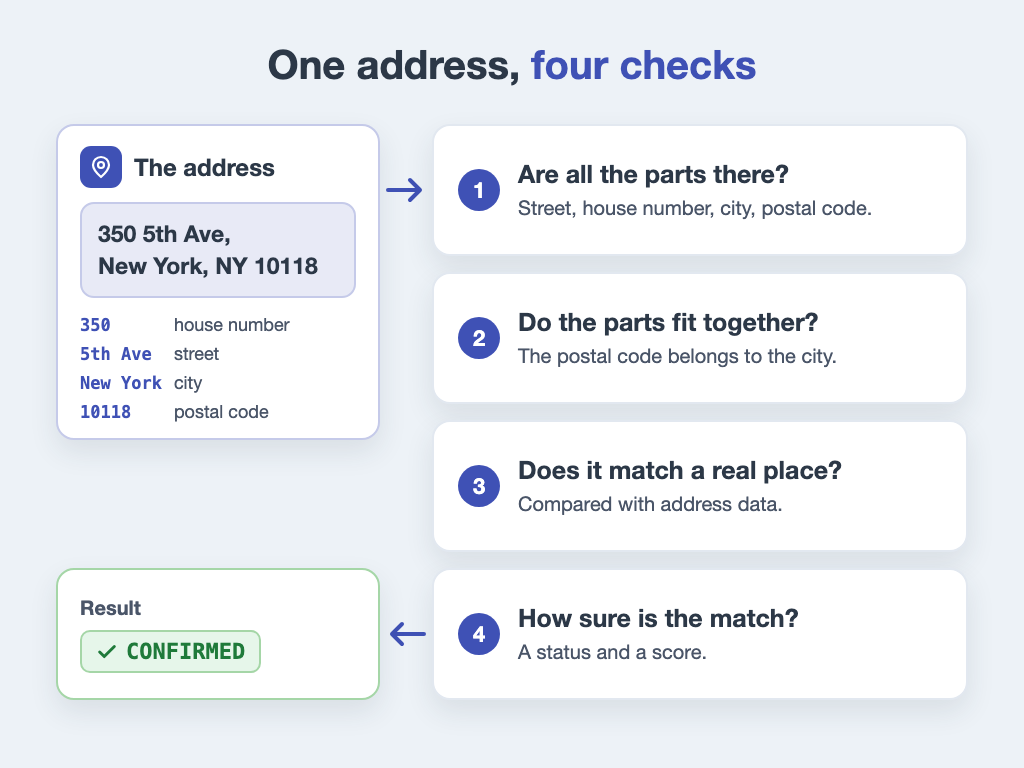
Four questions for every address on your list.
- Are all the parts there? A full address has a street, a house number, a city, a postal code and, for lists from many countries, a country.
- Do the parts fit together? The postal code should belong to the city, and the street should be in that city.
- Does it match a real place? The service looks for the street and the house number in its address data.
- How sure is the match? You get a status, and often a score, so you can find the doubtful addresses fast.
Here are three addresses and their results from the Address Validation tool on GeoSearch.online:
| Your address | Status | What it means |
|---|---|---|
350 5th Ave, New York, NY 10118 | CONFIRMED | The address matches a real place: the Empire State Building. |
8800 S Wacker Dr, Chicago, IL | PARTIALLY_CONFIRMED | The street is real, but this house number is not found. |
999 Nowhere Imaginary Rd, Zzyzxville | NOT_CONFIRMED | No such street or town. |
Checked on November 17, 2026.
A good service also gives each address back in a clean, full form. For the first row, that is "Empire State Building, 350 5th Avenue, New York, NY 10118, United States of America". Notice that "Ave" became "Avenue".
What a Service Cannot Tell You
A match means the place exists in the address data. It does not mean that a letter will arrive, or that the person still lives there.
| A check against address data can tell you | It cannot tell you |
|---|---|
| Whether the address matches a real place | Whether mail is delivered there |
| Which part of the address is in doubt | Whether the person or company is still at that address |
| The full, clean address | Whether an apartment or suite number is right |
Delivery is known to the postal service. Some services work with postal records and can answer more of these questions. That is the third kind of service below. Our guide to postal address verification explains this part in detail.
Three Kinds of Address Validation Service
The check is similar every time. The difference is how you use the service, and which data it checks against.
| Kind | What you do | Good for | You need |
|---|---|---|---|
| An online tool | Upload a list, download it with a status for every row | A list, once or now and then | A file with your addresses |
| An API | Your website or app sends each address and gets the answer back | Order forms and apps that check addresses all the time | A little code and a key |
| A postal-certified service | A mailing company, or special software, checks your list against postal records | Big mailings | A contract or special software |
An Online Tool
You open a web page, upload your spreadsheet and choose the address columns. A moment later you download the result. There is nothing to install and no code to write.
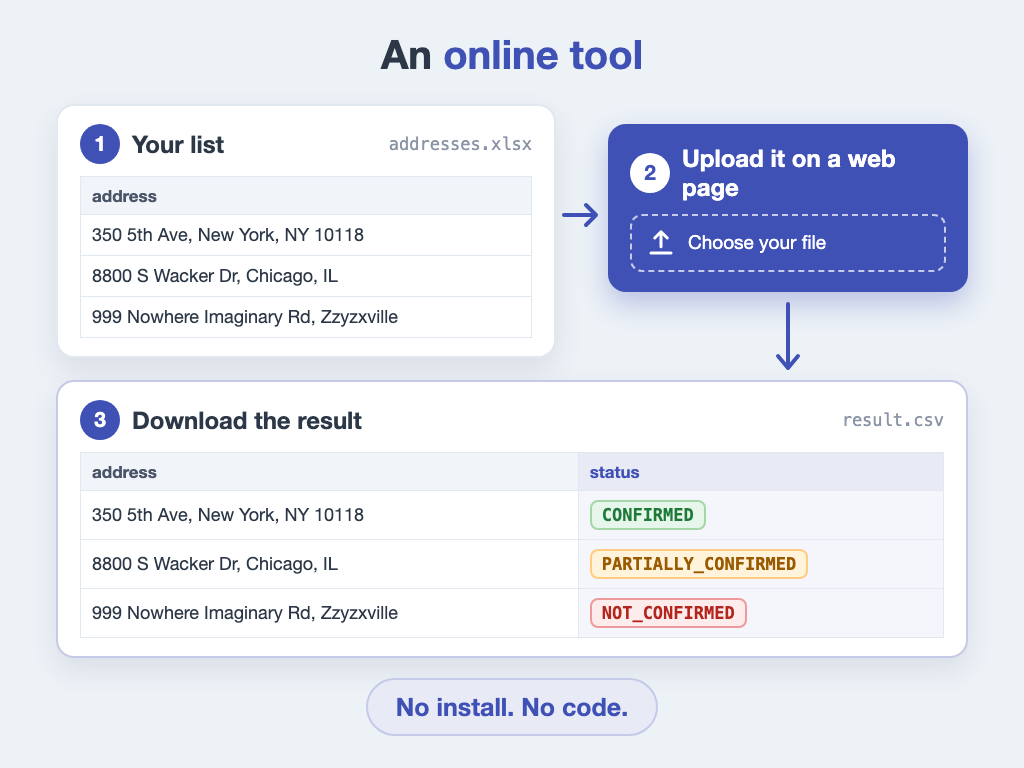
Your list goes in. The same list comes out with a status for every row.
An online tool is good for:
- A list you check once or now and then: a member list before the yearly letter, guests for a wedding, customers before a mailing.
- People who do not write code: if you can save a spreadsheet, you can use it.
- A first look: you see fast how many addresses need fixing.
GeoSearch.online has an online tool for this. It is free for up to 2,500 rows per run, with no sign-up.
Where it stops: you upload the list by hand each time. If new addresses arrive every day, for example in an online shop, that gets tiring. Then an API is the better fit.
An API
API stands for "application programming interface". It is a door for programs, not for people. Your website sends an address to the service and gets the answer back, without anyone clicking. You get a key from the service, so it knows who is asking.
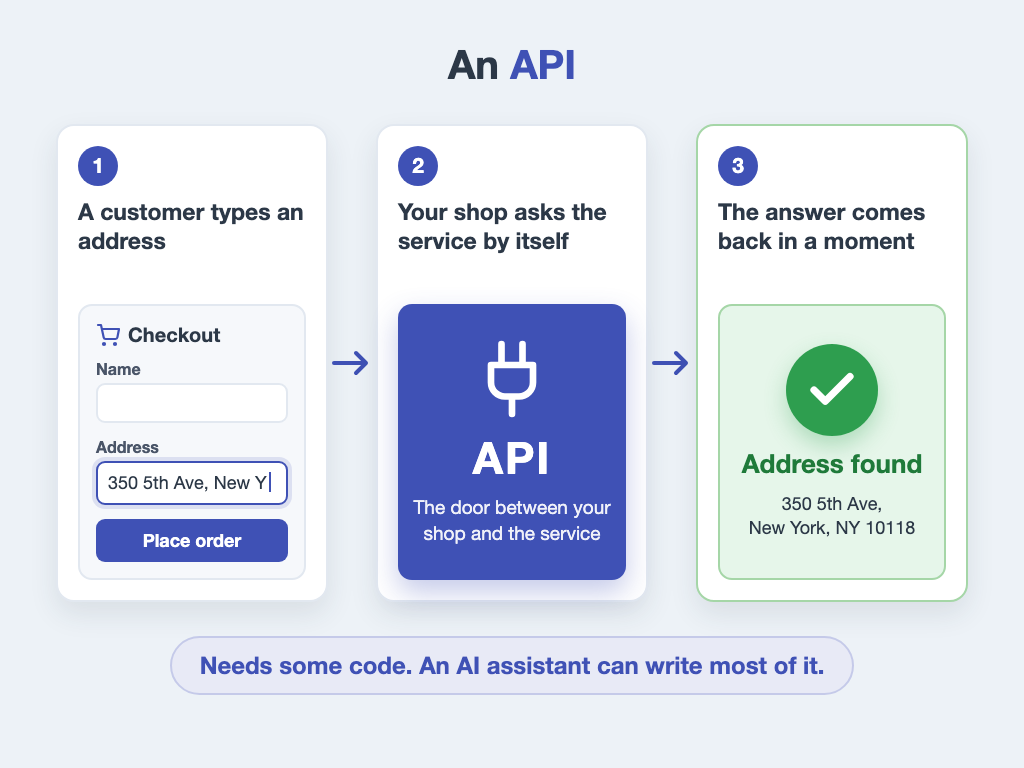
The shop checks each new address by itself.
An API is good for:
- Order and sign-up forms: the address is checked while the customer is still on the page and can fix it.
- Addresses that arrive all the time: nobody has to upload anything.
For a long time, an API meant hiring a programmer. That has changed. AI coding assistants can now write most of the code from a plain description, for example: "When a customer types an address in my order form, check it with this address validation API and show a hint if it is not found." You still need the key, and you should keep it private. Test the result on a few addresses first.
Many companies offer an API that checks addresses. A few of them, in alphabetical order:
- Geoapify Geocoding API
- Google Maps Platform Address Validation API
- Loqate Address Verification
- Melissa Address Verification
- Smarty US Address Verification
- USPS Addresses API
They differ in the countries they cover, the data they check against, their free amount, prices and terms of use. Read these on each provider's own pages before you choose. Links checked on November 17, 2026. The tools on GeoSearch.online use the Geoapify Geocoding API.
A Postal-Certified Service
Some jobs need the postal service's own records. The main one is a big mailing: thousands of letters or catalogs sent at once.
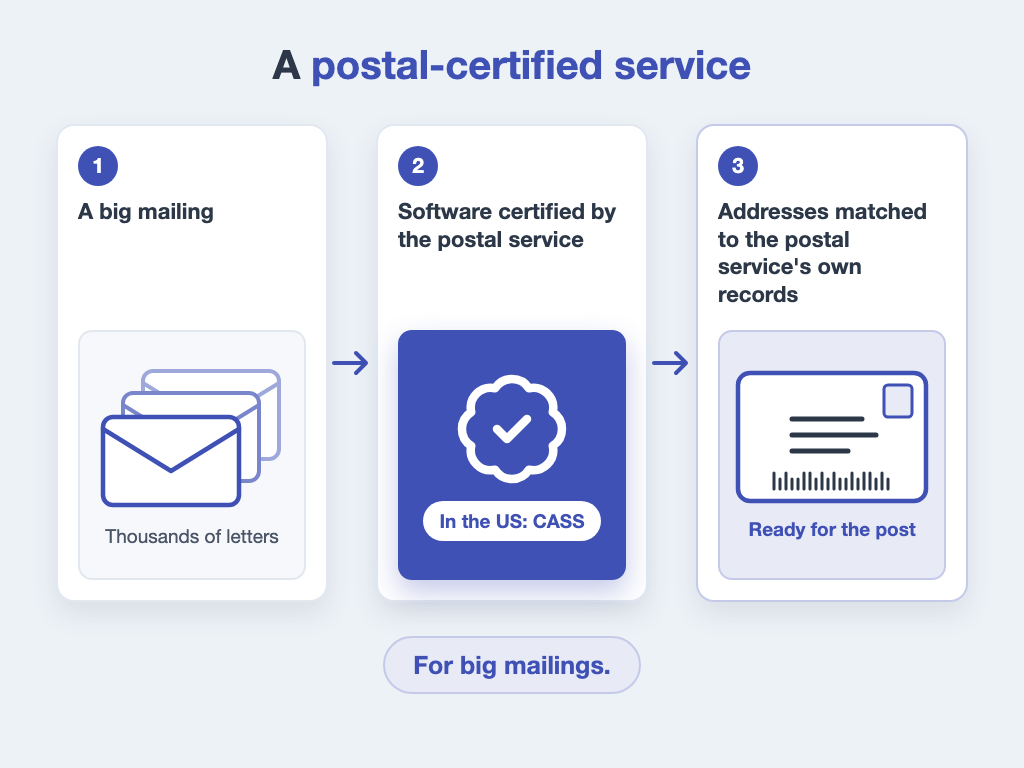
For big mailings, the check uses software the postal service has tested.
In the United States, the postal service (USPS) tests address software in a program called CASS. USPS says CASS gives software makers and mailers "a common measure by which to test the quality of address-matching software". It also says that a mailing sent at the lower "automation" prices must come from a list checked with CASS-certified methods.
USPS has a second service for people who moved, called NCOALink. It holds about 160 million change-of-address records from people and businesses who told the postal service about a move. Companies with a license from USPS use it to update mailing lists before the mail goes out.
You usually do not run this yourself. A mailing company, or special software, does it for you. That is why people call it a managed service.
A postal-certified service is good for:
- Big mailings, where postal discounts and returned letters cost real money.
- Lists that must follow postal rules.
For a few letters or a club list, you do not need it. In other countries, ask your postal service which checks it offers.
USPS publishes its own lists of companies and software. They are the place to start when you look for a provider:
- CASS certified products guides: the software and service companies that passed the CASS test.
- NCOALink Full Service Provider Licensees: companies with a license to update the addresses of people who moved.
- Certified vendors and providers: all USPS certification programs on one page.
Sources: USPS PostalPro: CASS and USPS PostalPro: NCOALink, checked on November 17, 2026.
Which One Do You Need?
Ask yourself how many addresses you have, how often they arrive, and what you will do with them.
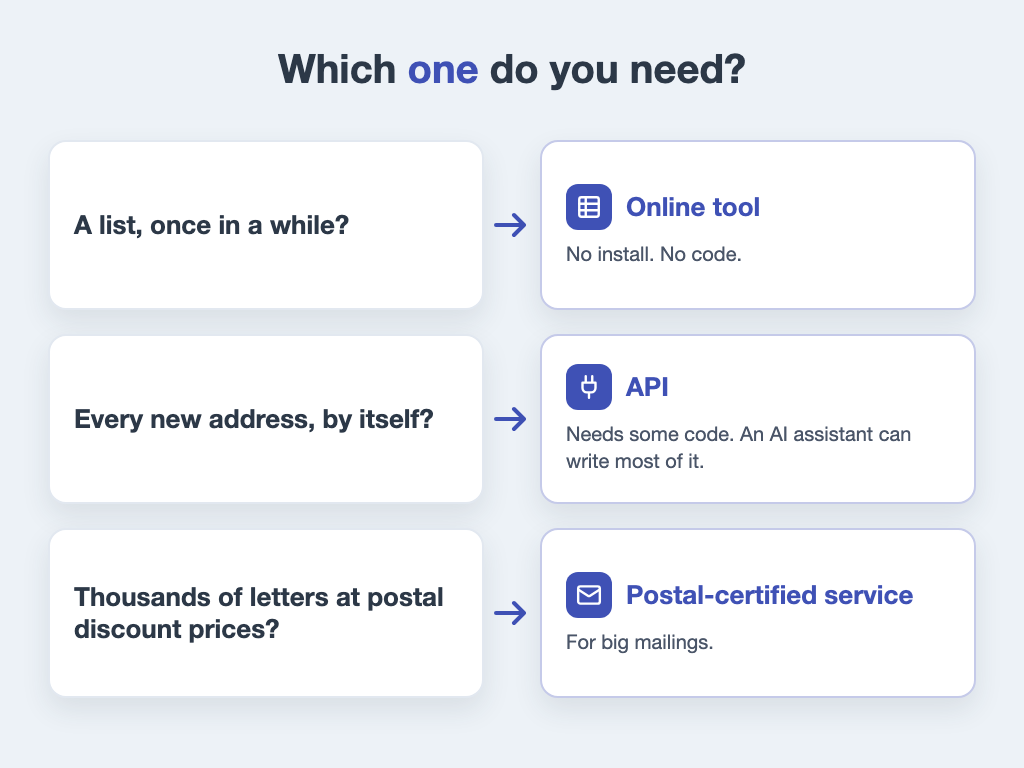
A list, a form, or a big mailing: each has its own kind of service.
A club with 800 members that sends one letter a year? Upload the list to an online tool. An online shop that takes new orders every day? That is a job for an API. A charity that mails 50,000 letters at postal discount prices? Talk to a mailing company that uses postal-certified software.
You can also mix them. Many people clean their list with an online tool first, and send only the big mailing through a mailing company.
What to Compare Before You Choose
Services look alike from the outside. These questions show the difference:
- What exactly is checked? That the place exists, or also that mail is delivered there?
- Which countries? Some services cover one country, others work worldwide.
- How much is free? Count your rows. Check the free amount, the price per row and any minimum payment.
- Which files work? Can you upload your file as it is? What do you get back?
- Do your own columns stay? You want your names and customer numbers next to the result.
- Is there a status for every row? A status, and the part in doubt, help you fix addresses fast.
- Where does the data come from? Open map data, postal records, or both.
- What happens to your file? Check how long it is stored and when it is deleted.
How to Check a List with GeoSearch.online
Here is the online tool way, step by step, with the Address Validation tool.
- Paste your addresses, or upload an XLSX, CSV or text file.
- Choose the columns: street, city, postal code and country.
- Click Verify.
- Download the results as a CSV file. Your own columns stay, and new columns are added.
The new columns hold:
- A status:
CONFIRMED,PARTIALLY_CONFIRMEDorNOT_CONFIRMED. - The part in doubt for partly confirmed addresses: the building, the street or the city.
- Confidence scores from 0 to 1. A score close to 1 means a sure match.
- The clean, full address and its parts, like street, city and postal code.
- The coordinates: latitude and longitude, two numbers that point to one spot on the map.
- The data source with its license.
The answers to the checklist, for GeoSearch.online:
- What is checked: whether the address matches a real place in open data from OpenStreetMap, OpenAddresses and GeoNames. These are not postal records, so the check does not confirm mail delivery.
- Countries: worldwide. Add a country column, or choose a default country.
- Free: up to 2,500 rows per run, with no signup and no credit card.
- Bigger files: €1 per 1,000 rows, with a €20 minimum. You pay once, with no subscription. See Pricing.
- Who does the work: our servers do the check. Paid jobs run in the background, and you get an email with the download link.
- Your file: it is deleted automatically after 7 days.
Want every step with screenshots? Read How to Validate an Address Online for Free.